Parkinson's Disease Physiotherapy Treatment in Ahmedabad
Improve Walking Balance and Maintain Daily Independence with Expert Care
Navigating Parkinson disease, resting tremors, muscle stiffness, or freezing of gait? At Complete Care in Ahmedabad, our licensed neuro physiotherapists provide specialized Parkinson rehabilitation, large amplitude movement training (LSVT BIG principles), rhythmic sensory cueing, and fall prevention balance drills for lasting walking confidence.
Parkinson's Disease: Symptoms, Gait and Balance Challenges
What Causes Parkinson's Disease Movement Symptoms?
Parkinson disease is a progressive neurodegenerative condition caused by the gradual loss of dopamine producing nerve cells in the substantia nigra region of the brain. Because dopamine is essential for smooth, automatic motor coordination, its deficiency disrupts automated movement sequencing, creating slowness, severe stiffness, resting tremors, and loss of postural reflexes.
Bradykinesia & Hypokinesia
Extreme slowness in initiating voluntary movement and progressive shrinking of movement amplitude, resulting in small shuffling steps and quiet speech.
Cogwheel & Lead-Pipe Rigidity
Persistent resistance to passive movement throughout the body, causing muscle tightness in the neck, shoulders, and trunk.
Freezing of Gait (FOG)
Sudden episodes of feeling like the feet are glued to the floor when initiating steps, turning around, or passing through narrow doorways.
Postural Instability & Stooped Posture
Loss of automatic balance reactions leading to forward flexed posture (camptocormia) and an increased risk of backward falls (retropulsion).
Common Motor Symptoms Managed by Neuro Physiotherapy
- Short Shuffling Steps and Festination: Involuntary quickening of small steps with reduced arm swing during walking.
- Difficulty with Bed Mobility and Chair Rising: Struggling to turn over in bed or rise from low armchairs without assistance.
- Resting Tremor in Hands or Chin: Involuntary rhythmic shaking that occurs at rest and decreases during purposeful movement.
- Micrographia and Fine Motor Decline: Progressive shrinking of handwriting and difficulty buttoning clothing.
Large-Amplitude Movement Training (LSVT BIG Principles)
Parkinson disease distorts the brain internal perception of movement size, making patients believe their small shuffling steps are normal. Our therapists use high amplitude, exaggerated movement protocols to recalibrate sensory-motor perception, restoring normal stride length and posture.
Using External Sensory Cues to Overcome Freezing
When automated internal brain circuits fail, external visual cues (lines on the floor, laser light pointers) and auditory rhythmic metronome beats bypass the damaged basal ganglia, enabling patients to step smoothly through doorways without freezing.
How We Assess Parkinson's Disease at Complete Care
Clinical Assessment
Our assessment begins with staging Parkinson progression using the Hoehn and Yahr Scale (Stages 1 to 5) and the Movement Disorder Society UPDRS motor examination.
Posture, Rigidity, and Gait Dynamics Assessment
We evaluate spinal rigidity, measure forward head and thoracic curvature angles, assess arm swing symmetry, and record 10-meter walking speed and step cadence.
Identifying Balance and Retropulsion Risks
- The Pull Test (Postural Retropulsion): Testing automatic backward stepping reflexes to quantify immediate fall risk.
- Mini-BESTest Balance Battery: Evaluating anticipatory postural adjustments, reactive stepping, and sensory orientation.
- Freezing of Gait Questionnaire (FOG-Q): Documenting specific situational triggers (tight turns, elevators, doorways) to design customized cueing strategies.
Parkinson's Disease Treatment at Complete Care
Large-Amplitude Movement Therapy
High intensity, large amplitude reaching, stepping, and twisting drills recalibrate motor output, expanding small, hesitant movements into big, confident steps.
Rhythmic Auditory and Visual Cueing
We train patients to utilize metronome sound beats, musical rhythm pacing, and visual floor stepping targets to overcome gait hesitation and freezing spells.
Spinal Extension and Postural Realignment
Thoracic extension mobilizations, chest opening stretches, and back extensor strengthening counteract stooped posture, improve lung capacity, and stabilize eye gaze.
Dual-Task Cognitive Balance Training
Combining balance stepping drills with verbal tasks (counting backward, naming objects) trains the brain to maintain walking safety during everyday distractions.
Personalised Physiotherapy Treatment
We provide an ongoing, supportive movement maintenance program tailored to medication on/off cycles, ensuring maximum daily functional independence.
Exercises for Parkinson's Disease Management
Big Stepping and High Knee Marching
Exaggerated marching and multi-directional stepping drills rebuild natural heel strike and prevent shuffling steps:
- High Knee March with Exaggerated Arm Swings: Lifting knees high and swinging opposite arms wide resets normal walking rhythm.
- Multi-Directional Big Lunges: Stepping forward, backward, and sideways with open hands builds reactive balance power.
Trunk Rotation and Chest Opening Exercises
- Seated Trunk Twists with Big Claps: Rotating the torso with wide open arms breaks axial rigidity and facilitates easier rolling in bed.
- Corner Chest Stretches: Opening tight pectoral muscles counters forward stooped posture.
Bed Turning and Chair Transfer Drills
Breaking complex bed rolling into segmented steps (head turn, knee bend, reach across) ensures effortless nighttime movement.
Home Safety and Anti-Freezing Tips
We provide advice on removing doorway rugs, using contrast colored tape lines on floors, timing exercise sessions during peak medication on states, and unfreezing tricks (weight shifting, stepping over an imaginary laser line).
Why Choose Complete Care for Parkinson's Disease?
Specialized Neuro Physiotherapy Team
Led by Dr. Hardik Patel (PT) with advanced expertise in movement disorders, basal ganglia neuro-rehabilitation, and cueing protocols.
Personalised One-on-One Care
Dedicated sessions scheduled around your medication on/off cycles for optimal physical performance and endurance.
Evidence Based Movement Protocols
Utilizing proven large amplitude exercise principles, rhythmic sensory cueing, and cognitive dual-task balance drills.
Care Available Across Gujarat
Over 85,000+ successful patient recoveries across our 6 clinical centres and dedicated doorstep home visit network.
Your Parkinson's Disease Treatment Journey
Initial Mobility & Balance Assessment
A thorough 45-minute clinical consultation evaluating Hoehn and Yahr stage, gait freezing triggers, posture angles, and fall risks.
Large-Amplitude Rehabilitation Sessions
Big stepping drills, rhythmic auditory cueing, trunk rotation exercises, and chair transfer mastery during your visits.
Progress and Lifelong Maintenance
Continuous walking speed monitoring, home environment adaptations, freezing prevention routines, and caregiver empowerment.
Parkinson's Disease Treatment Cost in Ahmedabad
Physiotherapy Consultation and Session Cost
The cost of Parkinson disease physiotherapy in Ahmedabad typically ranges from ₹500 to ₹2,000 per session depending on whether treatment is conducted in clinic or as a doorstep home visit, and the need for specialized large amplitude movement coaching, rhythmic auditory cueing, or intensive fall prevention training.
When Should You Start Parkinson's Physiotherapy?
Physiotherapy should begin immediately upon receiving a Parkinson diagnosis, rather than waiting for severe balance issues to arise, to build neuro-protective movement reserves early.
Emergency Red Flags & Immediate Medical Warning Signs
Frequently Asked Questions About Parkinson's Physiotherapy
Expert Physiotherapist in Ahmedabad
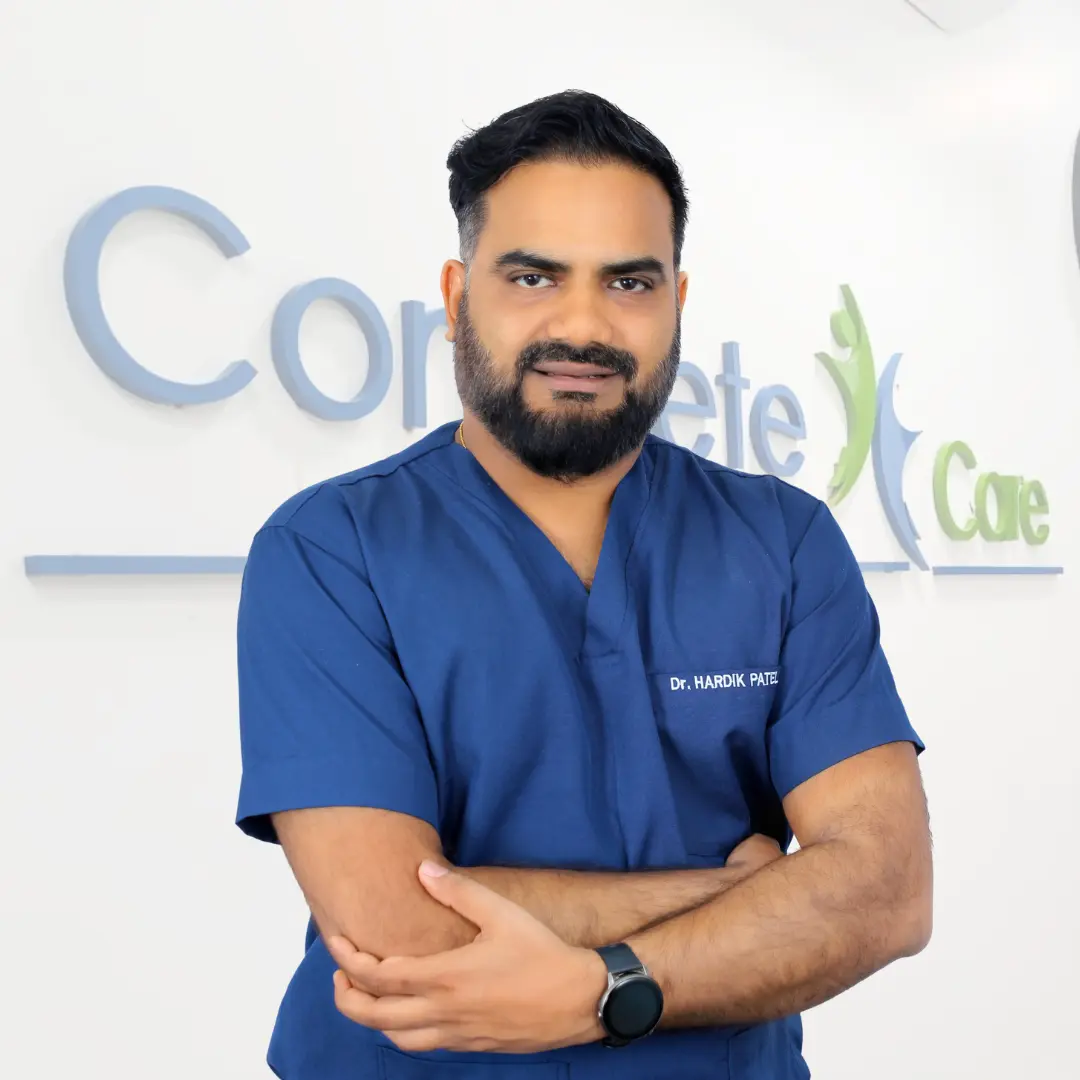
MPT in Orthopaedics (CCS University) · Certified Manual Therapist (FOMT Australia) · 16+ Years Experience · 85,000+ patient recoveries across 6 Gujarat centres.
Related Care Pathways
4.9 ★ Rated on Google Across 6 Gujarat Clinics (85,000+ Patient Recoveries)
Real recovery experiences from patients across Ahmedabad, Mehsana, and Ankleshwar in English, ગુજરાતી, and हिंदी.
“Underwent non surgical spinal decompression and PEMF therapy for severe L4-L5 disc slip. Within 3 weeks, my sciatica nerve pain dropped from 9/10 to zero. Dr. Hardik Patel's team is exceptional.”
“Mara knee pain ma bahu sari rahat mali. Complete Care Thaltej na staff no nature khub j saras ane cooperative chhe. Advance machines ane doctor na guidance thi fast relief mali.”
“Dr. Hardik Patel sir ne problem ko bohot deep samajh ke treatment plan banaya. Back spasm aur severe leg pain bilkul theek ho gaya bina kisi heavy medication ke.”