Physiotherapy for Bell’s Palsy Facial Movement
- complete\_care
- August 19, 2026
- Bell's Palsy Physiotherapy
Bell’s Palsy can strike abruptly and may cause paralysis of one side of the face, causing the person to experience expressions and normal activities that suddenly become challenging. Weakening facial muscles may make it difficult to smile, close the eye, drink, eat, talk or make facial expressions.
Healing is different for each person. Some people get better on their own, others may have facial weakness, stiffness, unwanted muscle movements or different sides of the face. The physiotherapy programme can be incorporated into the rehabilitation plan by assisting the patient in their controlled facial movements and functional use of affected muscles.
The use of a customized physiotherapy program for Bell’s palsy should be contingent upon the assessment of the qualified healthcare professional, the stage of recovery and the symptoms of the individual. Complete Care’s Bell’s Palsy service outlines some of the exercises, massage, neuromuscular re-education and selected electrotherapy techniques that are offered as part of rehabilitation.
Important: Sudden facial weakness can sometimes be a sign of a stroke or another serious neurological problem. New facial paralysis should receive prompt medical assessment rather than being assumed to be Bell’s Palsy.
What Is Bell’s Palsy?
Bell’s Palsy is a condition involving weakness or paralysis of the facial muscles, usually affecting one side of the face. It is associated with dysfunction of the facial nerve.
Depending on the severity, a person may notice:
- Difficulty smiling normally
- Drooping of one side of the face
- Difficulty closing one eye
- Changes in facial expression
- Difficulty eating or drinking
- Drooling
- Facial muscle weakness
- Increased sensitivity to sound
- Dryness of the eye or mouth
Complete Care lists several of these symptoms on its Bell’s Palsy treatment page.
Because symptoms and recovery patterns differ, rehabilitation should not rely on a generic set of exercises.
How Bell’s Palsy Affects Facial Movement
The facial nerve controls many muscles responsible for facial expressions and other functions. When nerve function is disrupted, the affected muscles may not receive normal signals from the brain.
This can make simple movements difficult.
For example, a person may be able to move the unaffected side normally while the affected side moves less or not at all. This difference can become particularly noticeable while:
- Smiling
- Raising the eyebrows
- Closing the eyes
- Blowing the cheeks
- Speaking
- Drinking
- Eating
The goal of rehabilitation is to help restore useful, controlled movement while avoiding unnecessary strain.
How Physiotherapy Supports Bell’s Palsy Recovery
The approach to Bell’s palsy physiotherapy treatment depends on the person’s stage of recovery and individual presentation.
Rather than simply asking patients to repeatedly move their facial muscles, a physiotherapist can assess facial movement and design an appropriate rehabilitation strategy.
#### 1\. Facial Movement Retraining
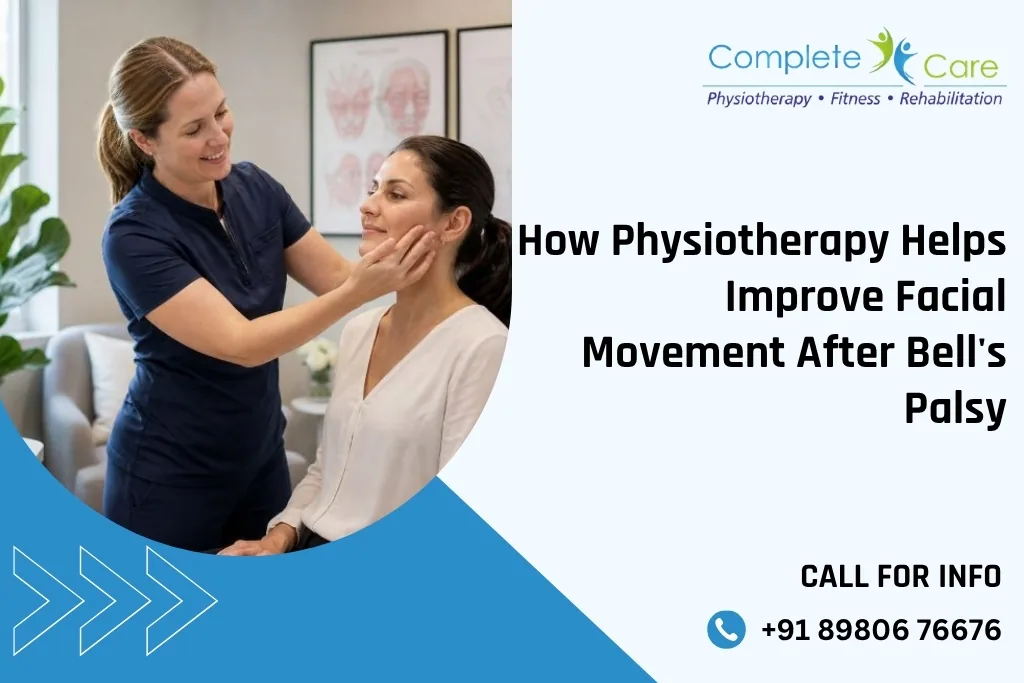
Facial movement retraining focuses on controlled activation of specific facial muscles.
Depending on the individual’s condition, therapy may involve practicing movements such as:
- Gentle smiling
- Raising the eyebrows
- Closing the eyes
- Moving the lips
- Controlled cheek movements
The emphasis should be on quality and control, rather than performing excessive repetitions.
#### 2\. Improving Facial Muscle Coordination
Some people may experience difficulty coordinating facial movements during recovery.
A physiotherapist may use carefully selected exercises to help the patient become more aware of how different facial muscles are working.
This can help with functional movements required for:
- Eating
- Drinking
- Speaking
- Facial expressions
The exercises should be modified according to the patient’s response.
#### 3\. Addressing Facial Tightness
During recovery, some individuals may experience a feeling of tightness or altered movement on the affected side.
Appropriate physiotherapy techniques may help patients work on controlled movement and relaxation.
However, aggressive facial massage or forceful exercises should not be performed without professional guidance.
Bell’s Palsy Facial Exercises: What Should You Know?
Searching for Bell’s palsy facial exercises is common among patients who want to speed up their recovery. However, more exercise does not automatically mean faster recovery.
Facial muscles are small and closely coordinated. Performing movements incorrectly or repeatedly forcing a weak muscle may not be helpful.
A physiotherapist may recommend gentle, controlled exercises based on the person’s recovery stage.
#### Examples of Movement Practice
Under professional guidance, exercises may include:
- Gentle eyebrow movement
- Controlled smiling
- Lip movements
- Gentle eye-closing practice
- Cheek activation
- Controlled facial expressions
The exact exercises should be individualized rather than copied from a generic online routine.
Why Timing and Assessment Matter
Bell’s Palsy recovery can change over time. An exercise that may be appropriate at one stage may not be suitable at another.
For this reason, professional assessment is important before beginning an intensive facial exercise program.
A physiotherapist may evaluate:
- Facial symmetry
- Muscle activation
- Voluntary facial movement
- Coordination
- Functional difficulties
- Changes during recovery
This assessment helps determine the appropriate rehabilitation strategy.
Can Physiotherapy Restore Facial Symmetry?
Facial asymmetry is one of the most noticeable concerns after Bell’s Palsy.
When one side of the face moves differently from the other, expressions such as smiling can appear uneven.
Rehabilitation may focus on improving controlled movement and coordination between facial muscles. The outcome varies depending on factors such as:
- Severity of nerve involvement
- Time since symptoms began
- Individual healing response
- Existing facial movement
- Presence of unwanted associated movements
Physiotherapy should therefore focus on realistic functional goals rather than promising complete recovery for every patient.
Physiotherapy and Everyday Facial Functions
Facial rehabilitation is not only about appearance.
Facial muscles contribute to several everyday activities.
#### (1) Eating and Drinking
Weakness around the lips and cheeks can make managing food and liquids more difficult.
#### (2) Speaking
Changes in lip and facial muscle control can affect certain aspects of speech.
#### (3) Eye Protection
Difficulty closing the eye is particularly important because the eye may require medical attention and protection during the recovery period.
#### (5) Facial Expression
Improved facial movement can help patients communicate emotions more naturally.
These functional concerns should be discussed with the appropriate healthcare professional.
When Should You Seek Facial Physiotherapy?
Consider professional assessment if facial weakness continues to affect everyday activities or if recovery is not progressing as expected.
You may benefit from rehabilitation if you have:
- Persistent facial weakness
- Difficulty smiling
- Difficulty closing the eye
- Difficulty eating or drinking
- Reduced facial expression
- Facial tightness
- Uncoordinated facial movements
However, facial paralysis physiotherapy should follow appropriate medical diagnosis. Facial paralysis has multiple possible causes, and not every case is Bell’s Palsy.
Bell’s Palsy Treatment in Ahmedabad
If you are searching for Bell’s Palsy Treatment in Ahmedabad, choosing a rehabilitation center with experience in neurological physiotherapy can help ensure that treatment is tailored to your specific facial movement problems.
Complete Care provides Bell’s Palsy physiotherapy services in Ahmedabad and describes its approach as including facial exercises, neuromuscular re-education, massage, and selected electrotherapy techniques.
Tips for Supporting Recovery at Home
A home routine can complement professional rehabilitation when the exercises have been recommended by a physiotherapist.
Helpful habits include:
- Follow the prescribed exercise routine.
- Avoid excessive facial exercise.
- Perform movements slowly and with control.
- Protect the eye if you cannot close it properly, following medical advice.
- Attend follow-up assessments.
- Report new or worsening symptoms promptly.
- Be patient with the recovery process.
Recovery may not happen at the same speed for everyone, so comparing your progress with someone else’s can create unnecessary anxiety.
Conclusion
Bell’s Palsy can temporarily change how a person smiles, speaks, eats, closes their eye, and expresses emotions. While recovery varies, appropriately planned rehabilitation can help patients work toward better facial movement and functional control.
Physiotherapy for Bell’s palsy may include facial movement retraining, carefully selected Bell’s palsy facial exercises, coordination work, and other rehabilitation techniques based on individual needs. Professional Bell’s palsy physiotherapy treatment should be personalized rather than based on a one-size-fits-all exercise routine.
If you are looking for Bell’s palsy treatment in Ahmedabad, a professional assessment can help determine whether physiotherapy is appropriate for your symptoms and recovery stage. For persistent or unexplained facial paralysis, obtaining an accurate medical diagnosis should always come first.
This article is published for patient education and does not replace an in-person clinical assessment. For personalized diagnosis and treatment planning, contact our physiotherapists on +91 8980 676 676 or visit any of our six centres across Gujarat.