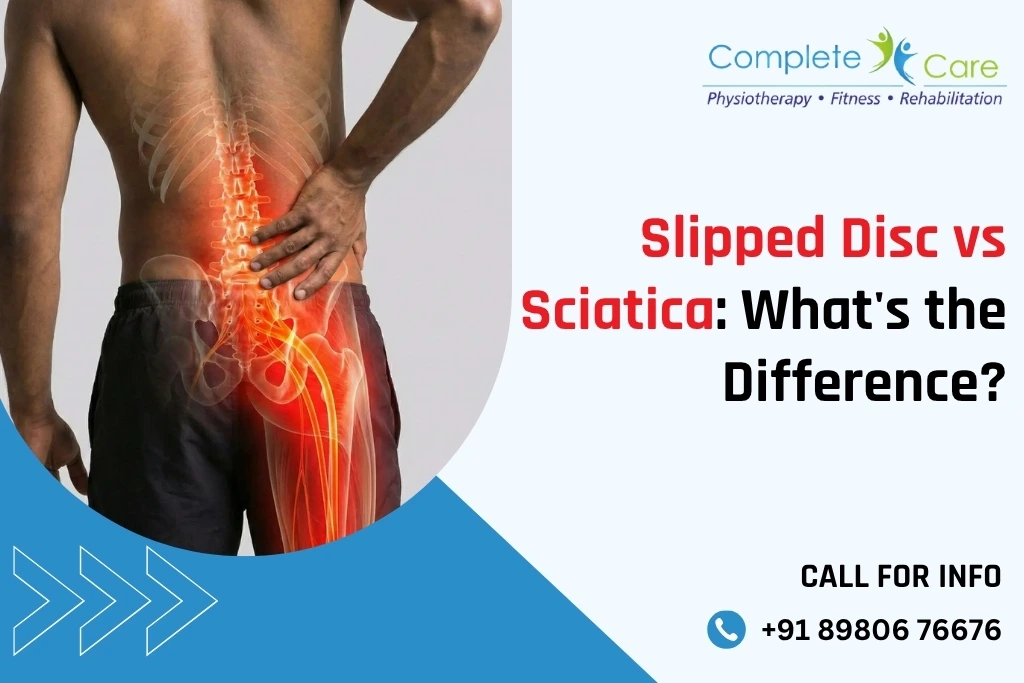
Slipped Disc vs Sciatica: What's the Difference?
- complete\_care
- September 28, 2026
- Back Pain
People often use these two terms as if they mean the same thing, but one is a problem in your spine, and the other is a symptom you feel. Here's how to tell them apart.
Medically reviewed by PT | Updated September 2026 | 7 min read
MEDICAL DISCLAIMER
This article is general information, not a diagnosis. Back and leg pain can have many causes, some serious. Always see a qualified doctor or physiotherapist for a proper assessment of your own symptoms.
QUICK ANSWER
A slipped disc and sciatica are not the same thing. A slipped disc (also called a herniated or prolapsed disc) is a structural problem where the soft cushion between two spine bones bulges out of place. Sciatica is a symptom: pain, tingling or numbness that travels from your lower back down through the buttock and leg, usually on one side. A slipped disc is the single most common cause of sciatica, but you can have one without the other.
Introduction
Back and leg pain is confusing, partly because the words get mixed up. "I've got a slipped disc" and "I've got sciatica" are often said to mean the same thing, but they describe two different ideas: one is what's happening in your spine, the other is what you feel because of it.
Understanding the difference matters, because it changes what you look for and how it's treated. This guide explains each in plain language, shows how they're linked, and tells you the warning signs that mean you should see a doctor quickly.
Key Takeaways
- A slipped disc is a structural change in your spine; sciatica is a set of symptoms.
- A slipped disc is the most common cause of sciatica, but not the only one.
- You can have a slipped disc with no pain at all, and sciatica from causes other than a disc.
- Most cases of both improve with time, movement and physiotherapy, and surgery is rarely needed.
- Some symptoms (bladder/bowel changes, saddle numbness) are emergencies: see the warning section.
What Is a Slipped Disc?
Between each pair of bones (vertebrae) in your spine sits a soft, cushion-like disc. Each disc has a tough outer ring and a soft, jelly-like centre. A "slipped disc" doesn't actually slip; rather, the soft centre pushes out through a weak spot in the outer ring. You may also hear it called a herniated, prolapsed, or bulging disc.
Here's the surprising part: many slipped discs cause no symptoms at all and are only found by chance on a scan. Problems start when the bulging disc presses on a nearby nerve. Depending on which nerve, that can cause back pain, or pain and tingling that spreads into an arm or leg.
What Is Sciatica?
Sciatica is not a diagnosis of a specific structure, but rather a pattern of symptoms. It happens when the sciatic nerve (the large nerve running from your lower back, through the buttock, and down the back of each leg) is compressed or irritated.
Typical sciatica feels like:
- Pain that radiates from the lower back or buttock down one leg, sometimes to the foot.
- Burning, shooting or electric-shock-like pain rather than a dull ache.
- Tingling, "pins and needles," or numbness along the leg.
- Occasional weakness in the leg or foot.
It almost always affects one side at a time.
Slipped Disc vs Sciatica: The Key Difference
The simplest way to remember it: a slipped disc is a cause; sciatica is an effect.
A slipped disc pressing on a sciatic nerve root is the classic cause of sciatica. But sciatica can also come from spinal stenosis (narrowing), bone spurs, or muscle problems, and a slipped disc can press on other nerves without ever causing sciatica.
Symptoms Compared
- Slipped disc without nerve pressure: may cause central or one-sided lower back pain, stiffness, or nothing at all.
- Slipped disc causing sciatica: back pain plus leg pain, tingling or numbness travelling below the knee.
- Sciatica: leg-dominant pain is the hallmark, where often the leg hurts more than the back. Pain may worsen when sitting, coughing or sneezing.
A useful clue: if your leg pain is worse than your back pain, nerve irritation (sciatica) is likely involved.
Causes
Common causes of a slipped disc:
- Age-related wear and tear of the discs.
- Sudden strain from heavy or awkward lifting, twisting.
- Repeated bending or poor lifting technique over time.
- Being overweight, smoking, and a sedentary lifestyle (which weaken disc health).
Common causes of sciatica:
- A slipped (herniated) disc pressing on a nerve root, which is the most common cause.
- Spinal stenosis (narrowing of the spinal canal), often age-related.
- Bone spurs or spondylolisthesis (a slipped vertebra).
- Less often, piriformis muscle tightness or, rarely, a tumour or infection.
How They're Diagnosed
For both, the diagnosis usually starts the same way: a doctor or physiotherapist takes your history and examines you, checking movement, reflexes, strength and sensation, and often doing a straight-leg-raise test that reproduces nerve pain.
Scans aren't routinely needed early on. An MRI is generally reserved for cases that don't improve, are severe, or show red-flag signs, because many people have disc bulges on imaging that aren't actually the source of their pain.
Treatment Options
The good news: treatment for both is similar, and most people recover without surgery.
Curious about the recovery timeline? Check out our detailed breakdown on how many physiotherapy sessions you need for back pain or browse our most common physiotherapy questions answered.
- Stay active. Prolonged bed rest slows recovery. Gentle movement and walking help.
- Physiotherapy. Guided exercises reduce pressure on the nerve, build supporting strength, and teach safe movement, the core of recovery for both.
- Pain relief. Short-term medication, heat or cold, as advised by your clinician.
- Time. Most slipped-disc and sciatica symptoms settle over weeks to a few months as inflammation reduces.
- Injections or surgery. Considered only for severe, persistent cases, or where there's significant nerve weakness or red flags, representing a small minority of patients.
What the Evidence Says
- Clinical guidelines (such as NICE and NHS guidance) recommend staying active and using exercise and physiotherapy as first-line care for both slipped-disc back pain and sciatica, rather than rest or early surgery.
- The majority of sciatica and disc-related symptoms improve within about 6 to 12 weeks with conservative (non-surgical) care.
- Routine imaging is discouraged for ordinary cases, because disc changes are common on scans even in people with no pain.
Sources include NICE guidelines on low back pain and sciatica, NHS patient information, and general orthopaedic references. Always follow the plan your own clinician gives you.
Prevention Tips
- Lift correctly by bending your knees, keep the load close, avoid twisting.
- Keep your core and back muscles strong with regular exercise.
- Set up your desk and chair to support good posture; take breaks from sitting.
- Maintain a healthy weight and stay active; avoid smoking (it affects disc health).
- Treat early niggles seriously and do not push through worsening back or leg pain.
Frequently Asked Questions
Q: Is a slipped disc the same as sciatica?
A: No. A slipped disc is a structural problem in the spine; sciatica is a symptom (nerve pain down the leg). A slipped disc is the most common cause of sciatica, but they are not the same thing.
Q: Can you have a slipped disc without sciatica?
A: Yes. Many slipped discs cause no symptoms at all, or only local back pain, because they aren't pressing on the sciatic nerve.
Q: Can you have sciatica without a slipped disc?
A: Yes. Sciatica can also come from spinal stenosis, bone spurs, a slipped vertebra, or muscle problems.
Q: How long does sciatica from a slipped disc last?
A: Most cases improve within 6 to 12 weeks with active care and physiotherapy. A smaller number take longer or need further treatment.
Q: Do I need an MRI?
A: Not usually at first. Scans are reserved for severe, persistent, or red-flag cases, because disc changes show up on imaging even in pain-free people.
Q: Will I need surgery?
A: Rarely. The large majority of people recover with non-surgical care. Surgery is considered mainly for severe or persistent nerve problems.
The Bottom Line
A slipped disc is what's happening in your spine; sciatica is what you feel when a nerve is irritated, often by that disc. Both are common, both are usually manageable, and both respond well to staying active and working with a physiotherapist. The important thing is an accurate assessment, along with knowing the few warning signs that need urgent care.
EMERGENCY NOTICE: Seek urgent care now
Go to emergency care immediately if you have:
- Loss of bladder or bowel control, or difficulty passing urine.
- Numbness around the groin, buttocks or inner thighs ("saddle" area).
- Weakness or numbness in both legs.
- Rapidly worsening leg weakness.
These can be signs of cauda equina syndrome, a rare but serious emergency that needs treatment within hours, not days.
Ready for a clear answer? Book an assessment with Complete Care. We'll examine your back and legs, explain exactly what's causing your pain, and build a recovery plan.
This article is published for patient education and does not replace an in-person clinical assessment. For personalized diagnosis and treatment planning, contact our physiotherapists on +91 8980 676 676 or visit any of our six centres across Gujarat.